


Bone Grafting: Procedure Details
[price id=”5249″]
Everyone dreams of maintaining a beautiful smile. The upper and lower jaws are considered the foundation for creating a beautiful smile, as they are the supporting structure for all teeth. Their defects can impact not only the absence of teeth but also the appearance and features of the face. Bone grafting is recommended to restore the jawbone tissue.
Bone Grafting
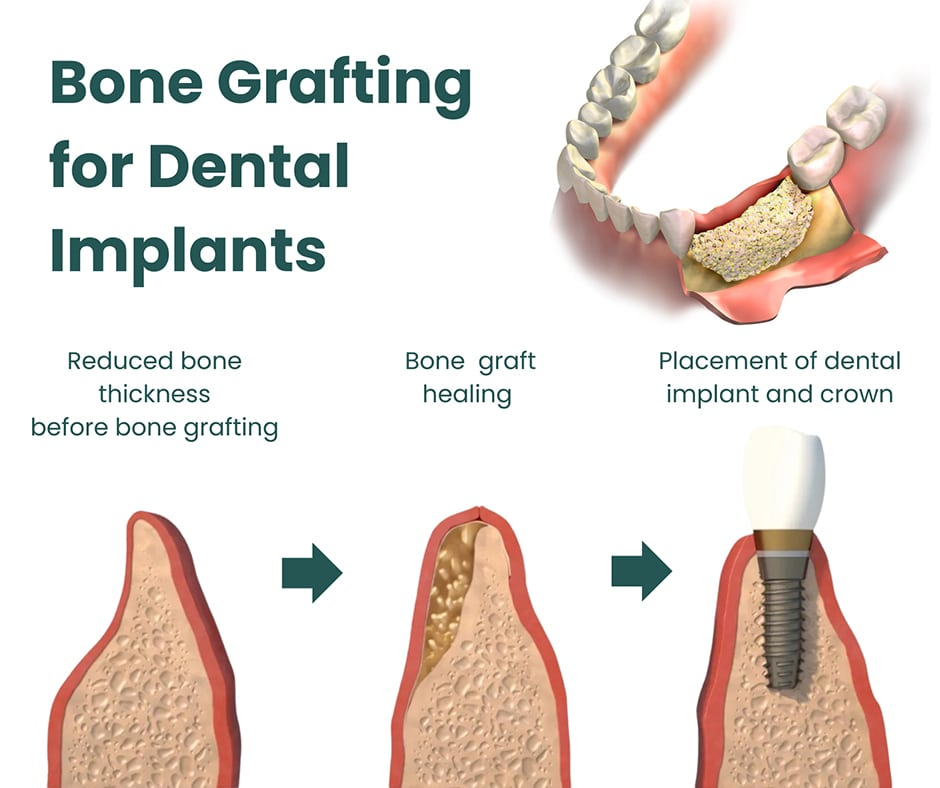
Bone grafting offers the possibility of reconstructing jawbone tissue where teeth are missing. This technique is most often used before dental implantation. Creating more volume in the jawbone is necessary for the reliable and correct installation of an implant.
Necessity of Bone Grafting
Various factors can affect the jawbone throughout life, causing changes in density and size. After a tooth is removed, bone atrophy occurs as the tissue ceases to be stressed.
The need for bone grafting depends on how much time has passed since the loss of a tooth. Regarding the lower jaw, its shrinkage occurs within six months to a year; for the upper jaw, it happens within a few months.
When is the Surgery Necessary?
The main indications for surgery include:
- Tooth removal with complications.
- Damage to the alveolar process.
- Atrophy caused by aging, genetic diseases, or osteoporosis.
Despite the causes of atrophy, the bone grafting technique is primarily performed to restore the jaw’s main function—chewing.
Contraindications to Bone Grafting
Not always is it possible to perform a surgery to restore jawbone. The main contraindications include:
- Blood diseases;
- Immunodeficiency state;
- Lactation period and pregnancy;
- Use of bisphosphonates;
Types of Materials
The bone grafting technique is chosen after analyzing the degree, direction, and location of atrophy. After determining the method of grafting, the type of material is selected. Its origin can be biogenic or synthetic:
- Autogenous – taking a piece of bone from a donor area in the patient. In the defect area, the bone is strengthened, known as autotransplant.
- Allogenic – taking a piece of bone from a donor area of another person. Some of the bone tissue elements are taken from a donor after their death. After processing, they are stored in small containers under special conditions.
- Xenogenic – a budget option due to the low cost of the material, with animals (cattle or pigs) serving as donors. This type of material is used in the form of bone blocks or granules.
- Alloplastic – material of synthetic origin (calcium phosphate) is used, most often for grafting the upper jaw.
Four Bone Grafting Technologies
Today, there are four types of bone grafting:
- After splitting the alveolar process, the bone along the ridge is sawed. Then, the channel is widened, and root-shaped implants are screwed in. Granules are placed in the formed cavity.
- Implantation of a bone block occurs in several stages. First, donor blood is taken from the patient. Then, the bone material is grafted and secured with titanium screws at the specified site. A membrane that eventually resorbs covers the regenerated area.
- For targeted bone regeneration, the gums are incised. The space is filled with bone substitute material, covered with a collagen membrane, and finally stitched.
- Sinus lifting – a technique involving the introduction of synthetic bone filler. Such surgical interventions can be of closed or open type.
Operation to Restore Jawbone
Restoring jawbone tissue is necessary because, in the case of jawbone atrophy, implantation is prohibited.
Stages of Bone Implantation
Before performing grafting on the lower jaw, the patient must undergo preparation. The preoperative examination begins with the sanitation of the oral cavity, investigating inflammation sites, and their elimination.
This procedure is necessary to avoid complications after surgery. A few days before the procedure, the doctor prescribes antibacterial treatment. Patients are advised not to smoke before and after surgery, so smokers undergo nicotine replacement therapy. The operation proceeds in several stages:
- Anesthesia of the augmentation area;
- Incision of the bone, exposing the necessary area;
- Attachment of bone material;
- Placement of a membrane to secure the bone material;
- Stitching at the intervention site. In case of any unusual symptoms such as severe pain, swelling, bleeding, or infectious manifestations, the patient must immediately consult a doctor.
Operation Features and Its Cost
For the operation, one needs to choose between synthetic or natural bone. It is worth noting that natural materials cost more than synthetic ones but integrate better. Regarding synthetic bone, it is cheaper but has a lower integration rate.
The procedure for augmenting bone tissue is an absolutely safe operation. However, it must be performed by qualified specialists, professionals in their field, in a hospital equipped with modern equipment.
The integration of bone substitute typically occurs within three to four months. After this, one can plan to carry out implantation, or implantation may be performed simultaneously with the bone graft.
After losing a dental row, it is recommended to begin treatment immediately. It is advisable to find a leading clinic for examination, after which the doctor will select an effective augmentation technique for future implantation.
It is worth noting that bone grafting is possible on both the upper and lower jaws. Specialists use hypoallergenic, safe, certified materials only from verified manufacturers. The price depends on the quality and type of chosen materials, the need for additional tests, and examinations.